Best Time to Visit Takayama & Shirakawa-go 2026: Weather & Travel Tips
Hi everyone — it’s Cathead here! 😺
If you’re dreaming of a mountain getaway that feels like a movie scene, look no further than the Hida region in Japan’s Gifu Prefecture. This area—encompassing Takayama, Shirakawa-go, Gero Onsen, and Hida-Furukawa—is where traditional Japan meets the breathtaking Japanese Alps.
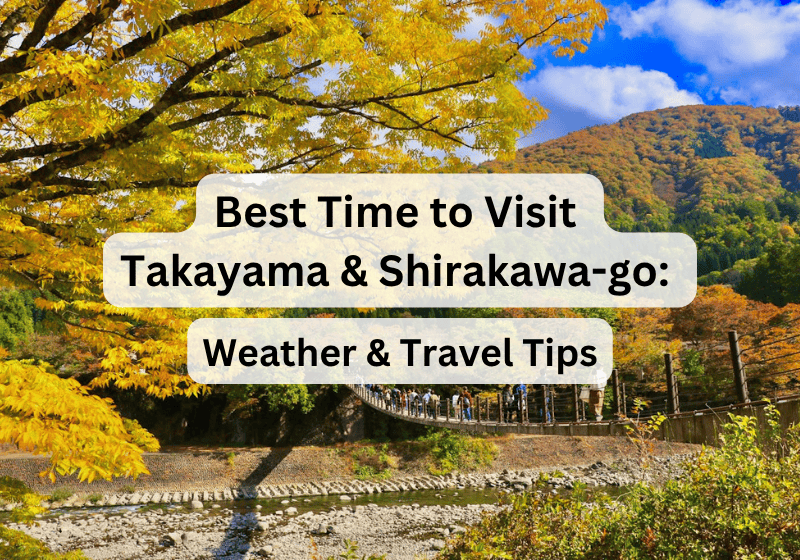
While this region is a postcard in every season, spring is truly special. Spring brings cherry blossoms, summer is lush and green, fall turns the valleys crimson, and winter blankets the villages in deep snow.
Whether you’re planning a road trip from Nagoya or taking the train from Kanazawa or Matsumoto, here is everything you need to know about visiting the Hida region this spring.
Let Cathead walk you through it all — season by season.
Table of Contents
🌸 Spring in Takayama & Shirakawa-go (March – May)
The Vibe: Crisp mountain air, cherry blossoms by old wooden streets, and snow slowly melting into fresh alpine green. Arguably the most balanced and photogenic season to visit.
Takayama & Shirakawa-go Weather in Spring

Spring in the Hida region arrives later than Tokyo or Kyoto because of higher elevation. It feels refreshing, peaceful, and incredibly scenic.
- March: ~41°F (5°C)
- April: ~52°F (11°C)
- May: ~61°F (16°C)
March: Still feels like winter. You’ll see snow patches in Shirakawa-go, but the crowds are much smaller.
April: By mid to late April, cherry blossoms bloom in Takayama.
May: Blue skies, fresh greenery, and comfortable walking temperatures.
Things to do in Takayama & Shirakawa-go in Spring
🌸 Cherry Blossoms Along the Miyagawa River (Mid–April)
By mid-April, the Miyagawa River becomes the star of the season. Pale pink petals arch over the water against the backdrop of traditional merchant houses. Unlike the massive crowds in Kyoto, the blossoms here feel intimate and local.
🏮 Takayama Spring Festival (Sanno Festival)
Held every year on April 14–15, this is one of Japan’s most spectacular float festivals. During the day, ornate wooden festival floats (yatai) parade through the streets of Takayama. At night, lanterns illuminate the town, casting a warm glow over the historic district.
The entire atmosphere feels like stepping back into the Edo period. If you want to experience Takayama at its most culturally vibrant, spring festival season is unbeatable.
🏘️ Sanmachi Old Town & Takayama Jinya
Sanmachi Suji is Takayama’s most iconic walking district. Walk the narrow streets of Sanmachi Suji, where dark wooden houses host sake breweries and craft shops. You can’t leave without trying a Hida Beef skewer or grilled miso dumplings.
Just around the corner is the Takayama Jinya — a preserved Edo-period government office — adds historical depth to your stroll.
🎢 Shinhotaka Ropeway (Okuhida Area)
For the best views in the Japanese Alps, take this double-decker cable car up to 7,073 feet. In spring, you get a rare contrast: lush green valleys below and dramatic, snow-dusted peaks above.
I visited in late March once, watching mist drift between snow-dusted peaks. It honestly felt like a floating mountain kingdom.
🥁 Hida Furukawa Festival (April 19–20)
Just 15 minutes from Takayama, Hida-Furukawa offers a quieter but equally stunning experience. The festival is famous for its powerful taiko drum processions.
The deep drumbeats echo through white-walled streets, reflected in lantern-lit canals — intense yet refined. Even outside festival dates, the Hida Furukawa Festival Hall lets you experience the energy of those massive drums.
🛶 Hida Furukawa – Setogawa Canal & White Wall Storehouses
Clear canals lined with white plaster storehouses create one of the most serene spring walks in the region. Willow branches turn fresh green, koi fish glide through the water, and the atmosphere feels distinctly Edo-era.
It’s perfect for pairing with a relaxed half-day exploration around Furukawa Station — quieter than Takayama, but equally atmospheric.
What to Wear & Pack (Spring)
Spring in the mountains means layers are essential.
March / Early April:
A medium-weight coat or lightweight down jacket over sweaters. It can still dip near freezing in the mornings.
Late April / May:
Light knitwear or long-sleeve shirts. A light jacket is useful for cooler evenings.
Footwear: Wear comfortable walking sneakers or hiking shoes with good grip. The old town cobblestones and the paths in Shirakawa-go require sturdy support.
🌿 Summer in Takayama & Shirakawa-go (June – August)


The Vibe: Lush mountain landscapes, fresh alpine air, and peaceful countryside energy. A cooler alternative to Japan’s big cities.
Takayama & Shirakawa-go Weather in Summer
Summer in the Hida region feels very different from Tokyo or Osaka. Because Takayama sits at higher elevation, temperatures are noticeably milder.
- June: ~66°F (19°C)
- July: ~75°F (24°C)
- August: ~79°F (26°C)
June includes Japan’s rainy season, so expect occasional showers.
By mid-July, skies clear and the mountains turn deep green. Even when daytime highs reach the upper 70s°F (mid-20s°C), evenings cool down comfortably — often dipping into the 60s°F.
Humidity exists, but it’s far less intense than in major urban areas. If you’re escaping city heat, summer in Takayama feels surprisingly refreshing.
Takayama & Shirakawa-go Best Places to Visit in Summer
🏯 Takayama Jinya & Morning Markets
Start early. The Jinya-mae Morning Market comes alive with local farmers selling fresh vegetables, pickles, fruits, and handmade goods. Summer mornings are crisp and bright, making this one of the most pleasant times to explore before midday warmth sets in.
Takayama Jinya, the preserved Edo-period government office, feels cool inside — a welcome break from the sun.
🌾 Shirakawa-go Rice Fields & Shiroyama Observatory
In winter, it’s a snowy fantasy. In summer, it’s a rural masterpiece. The iconic Gassho-zukuri farmhouses are surrounded by vibrant green rice paddies and blooming wildflowers.
Hike up to the Shiroyama Observatory, you’ll see waves of green stretching across the valley — peaceful, pastoral, and deeply calming.
🎢 Shinhotaka Ropeway (Okuhida Area)
On hot summer days, heading higher into the Northern Alps feels like natural air conditioning. At 7,073 feet (2,156m), temperatures are noticeably cooler.
Clear summer skies provide some of the best visibility of the year. The layered mountain ridges seem endless, and the deep alpine green feels powerful and alive.
What to Wear & Pack (Summer)
Summer in the mountains still requires smart layering.
Clothing: Breathable fabrics for daytime, plus a light cardigan or jacket for cooler evenings.
Rain Prep: Compact umbrella or light rain jacket for June showers.
Footwear: Comfortable walking sneakers — you’ll still cover plenty of ground exploring old streets and village paths.
Sun Protection: Hat, sunscreen, and sunglasses — mountain sun can be strong, even when air feels cool.
🍁 Fall in Takayama & Shirakawa-go (September – November)

The Vibe: Crisp air, golden rice fields, fiery maple leaves, and lantern-lit festival nights. If you love dramatic scenery and comfortable weather, this is arguably the most photogenic season of all.
Takayama & Shirakawa-go Weather in Fall
Autumn in the Hida region is cool, dry, and incredibly pleasant for walking.
- September: ~70°F (21°C)
- October: ~59°F (15°C)
- November: ~48°F (9°C)
Early September can still feel warm, but by October the air turns crisp and refreshing. Skies are often clear, humidity drops, and visibility from mountain viewpoints improves dramatically.
By mid–late November, temperatures fall quickly and the first light snowfall may appear in higher elevations.
If you’re wondering:
Best time to visit Shirakawa-go for fall foliage?
👉 Late October to early November is peak color season.
Things to do in Takayama & Shirakawa-go in Fall
🏮 Takayama Autumn Festival (Hachiman Festival, Oct 9–10)
Often ranked among Japan’s most beautiful festivals, this autumn celebration rivals the spring festival in elegance. Intricately carved floats parade through the old town, and at night, lantern-lit processions create a warm glow against the cool autumn air.
The contrast of illuminated floats and crisp night skies feels romantic and cinematic — one of Takayama’s most atmospheric experiences.
🏘️ Sanmachi Old Town in Autumn Light
As maple leaves turn red and gold around the historic district, Takayama’s wooden merchant houses look even richer in color. Afternoon sunlight reflects off dark cedar façades, while cool breezes carry the scent of sake breweries.
It’s the perfect season for slow wandering, seasonal sweets, and warm drinks between photo stops.
🌾 Shirakawa-go’s Golden Rice Fields
Before harvest, rice paddies turn brilliant gold, surrounding the iconicGassho-zukuri farmhouses in warm tones. The mountains behind the village gradually shift into layers of red, orange, and amber.
Crowds are typically fewer than during winter illumination season, making fall a more relaxed time for photography.
🛶 Hida Furukawa – Setogawa Canal & White Wall Storehouses
In autumn, reflections of red maple leaves shimmer in the clear canal water. White plaster storehouses stand in elegant contrast to the warm seasonal tones.
This area feels especially peaceful in the late afternoon, when golden light hits the walls and the streets grow quiet. It’s ideal for travelers who appreciate subtle, refined beauty over dramatic spectacle.
What to Wear & Pack (Fall)
Fall weather changes quickly in the mountains, so layering is key.
September:
Light long sleeves for the day; a light windbreaker for the evening.
October:
Sweaters or knit tops with a trench coat or windbreaker.
November:
It gets chilly! Pack a heavy jacket or light down coat, especially for early morning market runs.
Footwear: Wear comfortable sneakers with good grip. Warning: Wet, fallen maple leaves can make those historic stone paths surprisingly slippery!
❄️ Winter in Takayama & Shirakawa-go (December – February)

The Vibe: Silent snowfalls, glowing lantern light, steaming hot springs — a true Japanese winter fairytale.
If you’ve ever dreamed of seeing traditional thatched-roof houses buried under snow, this is the season.
Takayama & Shirakawa-go Weather in Winter
Winter in the Hida region is cold and snowy, especially compared to Japan’s major cities.
- December: ~37°F (3°C)
- January: ~32°F (0°C)
- February: ~34°F (1°C)
Now let’s answer the most common winter questions:
Does it snow in Takayama in November?
Light snow is possible late November, but consistent snow usually begins in December.
Does it snow in Takayama in December?
Yes! Consistent snowfall usually begins by mid-to-late December.
When does it snow in Shirakawago?
Snow typically begins in December, with the heaviest accumulation in January and February.
If you’re planning specifically for snow scenery:
👉 Best time to visit Shirakawa-go for snow: January is your safest bet for that postcard-perfect, deep-snow coverage.
Takayama & Shirakawa-go Best Places to Visit in Winter
✨ Shirakawa-go Winter Light-up 2026
The famous illumination event usually takes place on select evenings in January and February (This event is reservation-only via a lottery system through the official Shirakawa-go Tourism Association.).
At night, warm amber lights glow against snow-covered gassho houses, transforming the village into something out of a storybook. Steam rises from chimneys, and snowflakes sparkle under lantern light — it’s magical but strictly controlled, so advance planning is essential.
🏘️ Ogimachi Village (Daytime Snow Scenes)
Walking through the village in winter feels like being inside a snow globe. The Gassho-zukuri houses are designed specifically to withstand heavy snow, and seeing them in person is a lesson in traditional engineering.
Head to the Shiroyama Observatory for the classic panoramic shot of the village.
Important reminder: walk carefully on icy paths and be respectful — this is a living village, not an open-air museum.
♨️ Gero Onsen Snow Bath Experience
After exploring in freezing temperatures, nothing feels better than soaking in an outdoor hot spring while snow falls around you.
Gero Onsen, one of Japan’s “Three Famous Hot Springs,” is especially memorable in winter. Warm mineral water against cold mountain air creates that perfect contrast every winter traveler dreams of.
What to Wear & Pack (Winter)
Winter in the Hida region requires proper cold-weather preparation.
The Outer Shell: A waterproof, insulated parka is a must.
Mid Layer: Sweaters or fleece.
Base Layer: Thermal heat-retaining innerwear.
Footwear: Waterproof boots with strong grip (snow can turn into ice quickly).
Accessories: A thick scarf, insulated gloves, and a beanie that covers your ears. The mountain wind can be sharp!
📝 What Are the Peak Season in Takayama & Shirakawa-go?
The Hida region has three main peak travel periods each year — all tied to dramatic scenery or major festivals.
❄️ January – February (Winter Snow & Light-up)
This is the most famous season, especially for Shirakawa-go’s heavy snowfall and the highly sought-after Winter Light-up event. Snow blankets the village, creating postcard-perfect scenes.
Hotels sell out quickly, and light-up entry requires advance lottery reservation. Book 3–6 months ahead if visiting during this period.
🌸 Mid-April (Spring Festival Season)
Mid-April is peak again due to back-to-back cultural celebrations:
- Takayama Spring Festival (April 14–15)
- Hida Furukawa Festival (April 19–20)
These festivals bring ornate floats, taiko drums, and a lively cultural atmosphere. Accommodations fill fast during this week.
🍁 October – November (Fall Foliage)
Fall is another high season thanks to vibrant foliage and the Takayama Autumn Festival (Oct 9–10). Crisp weather and colorful mountain views attract photographers and international visitors alike.
Booking Tip
During all three periods, reserve hotels and transportation at least 3 months in advance. For winter light-up details and 2026 updates, please check 👉the official website of Shirakawa-go Tourism Association.
🗓️ How Many Days Do You Need in Takayama & Shirakawa-go?
One of the most common questions I get is:
Can you do Shirakawa-go and Takayama in one day?
Technically, yes — but I wouldn’t recommend it unless you’re on a very tight schedule.
Here’s how I’d think about it.
🏘️ How Many Days Do You Need in Takayama?
For Takayama alone, 1 ½ to 2 days feels just right.
That gives you enough time to:
- Wander Sanmachi Old Town slowly (without feeling rushed)
- Visit Takayama Jinya
- Explore morning markets
- Try local Hida beef and sake
- Possibly add Shinhotaka Ropeway or Hida Furukawa
If you’re wondering:
Is 3 days in Takayama too long?
Not at all — especially if you enjoy slower travel, photography, or nearby day trips. Three days allows you to explore at a relaxed pace and include Okuhida or Gero Onsen.
🏡 How Many Hours Are Enough in Shirakawa-go?
For Shirakawa-go, most travelers spend 2–3 hours exploring Ogimachi village.
You can comfortably:
- Walk through the gassho house district
- Visit Wada House
- Go up to Shiroyama Observatory
- Stop for lunch or local snacks
So yes —
Is 2 hours enough for Shirakawa-go?
It’s enough for a quick overview. But 3–4 hours feels much more relaxed, especially if you want time for photos or a break at a café.
🚄 Can You Do Shirakawa-go and Takayama in One Day?
Logistically, it’s possible. Takayama to Shirakawa-go takes about 1 hour by bus or car, so some travelers do:
Nagoya → Takayama (morning) → Shirakawa-go (afternoon) → Return
But it feels rushed. You’ll spend more time watching the clock than enjoying the atmosphere.
I personally recommend:
✔ Stay overnight in Takayama
✔ Visit Shirakawa-go the next morning (arrive before 10am)
That pace feels much more balanced and lets you experience the magic of the Hida region without the stress!
🚗 Nagoya to Takayama? (Train vs. Bus vs. Drive)
🚆 Train (JR Hida Limited Express) — The Most Comfortable Choice
The JR Hida Limited Express runs directly from Nagoya Station to Takayama Station.
⏱ Travel time: ~2.5 hours
🎟 Reserved seats available
🌄 Scenic views: Incredible mountain vistas along the Hida River
This is the most popular and stress-free option. The ride itself is beautiful, especially once the train enters the mountain valleys.
If you value comfort, scenery, and reliability, the train is my top recommendation.
🚌 Highway Bus — Budget-Friendly Option
Direct highway buses also operate between Nagoya and Takayama (Meitetsu and Nohi Bus).
⏱ Travel time: ~2.5–3 hours
💰 Usually cheaper than the train
The bus is slightly slower and less spacious, but it’s a solid option for budget travelers. During peak seasons (fall foliage and winter light-up), these buses sell out weeks in advance, so reservations are a must.
🚗 Driving — Best for Flexibility
A road trip from Nagoya to Takayama is straightforward:
⏱ Travel time: ~2 hours
📍Distance: ~150 km (93 miles) via the Tokai-Hokuriku Expressway
If you plan to continue to Shirakawa-go, Gero Onsen, or Kanazawa, renting a car gives you maximum flexibility. Mountain scenery along the highway is stunning, especially in fall and winter.
However, winter driving requires snow tires and ideally AWD. If you aren’t comfortable driving in heavy snow, stick to the train or bus.
📍 What Is the Closest City to Shirakawa-go?
The two most practical nearby cities are:
🏘️ Takayama (Closest & Most Convenient)
Takayama is about 1 hour away by bus or car, making it the most convenient base for visiting Shirakawa-go.
Many travelers stay overnight in Takayama, explore the old town, and then take a morning bus to Shirakawa-go. The connection is frequent, making it the most logical pairing for a 2–3 day trip.
🏙️ Kanazawa (Slightly Farther, Very Popular Route)
Kanazawa is about 1 to 1.25 hours away by bus. It’s a larger city with direct train access to Tokyo, which makes it a common stop on broader Japan itineraries.
Some travelers visit Shirakawa-go as a day trip between Takayama and Kanazawa — it works well if you’re moving across central Japan.
🔎 Is Shirakawa-go Suitable for Self-Driving?
Yes—in fact, it’s often the easiest way to visit.
Since there is no train station in Shirakawa-go, you are usually limited to bus schedules. If you’re already exploring central Japan — especially from Nagoya, Takayama, or Kanazawa — renting a car offers much more flexibility.
- From Nagoya, it’s about 2–2.5 hours (roughly 90–95 miles / 150 km).
- From Takayama, it’s only about 1 hour.
Driving allows you to move at your own pace, stop for mountain views, and combine destinations like Takayama → Shirakawa-go → Kanazawa in one smooth route.
⚠️ Winter Note: From December through February, these mountain roads are icy. Snow tires are mandatory (and usually included in rentals in this region), but if you aren’t experienced with winter conditions, the highway bus is the safer, stress-free choice.
Outside of the heavy snow season, self-driving is often the most convenient and relaxed way to visit.
🔎 Shirakawa-go Parking for Self-Drivers
Here’s something important to know: you cannot drive directly into the gassho village.
All private vehicles must park in designated lots outside the village and walk in.
The two main parking areas are:
① Seseragi Park Parking (せせらぎ公園駐車場)
This is the primary lot most visitors use. It’s located just outside the village near the Shogawa River.
After parking, you’ll cross the Deai Bridge and reach the heart of Ogimachi Village in about 5–10 minutes on foot.
🚗 Parking fee: ~1,000 yen per standard vehicle
🚶 About a 5–10 minutes walk to the Ogimachi Village
📍 Location: South side of the village near the river
This lot fills up quickly during peak seasons.
② Midashima Park Parking (みだしま公園駐車場)
If the main parking lot is full, staff will redirect you to this secondary lot. It’s slightly farther but still within comfortable walking distance.
🚗 Parking fee: ~ 1,000 yen per standard vehicle
🚶 About a 10–13 minute walk to the village
📍 Location: Outer area of the village
During busy periods, staff will direct vehicles here once the main lot is full.
🐱 Cathead’s Practical Tip:
Aim to arrive before 10:00 AM. Parking is much smoother, and you’ll avoid large tour bus groups.
I once arrived around noon during a non-peak season, and even then the main parking lot was already full — I was redirected to Midashima Park.
Shirakawa-go has a good number of spaces, but peak seasons (winter light-up, fall foliage, festivals) can fill up fast.
Final Thoughts
What stays with me most about Takayama and Shirakawa-go isn’t just the scenery — it’s the feeling.
In spring, petals drift quietly through Sanmachi Old Town as sunlight hits the wooden façades.
In fall, the mountains glow in layers of gold and crimson.
In winter, Shirakawa-go lights up beneath falling snow, and the whole village feels suspended in time.
There are no skyscrapers here, no neon chaos — just cedar houses, mountain air, and seasons that move slowly and beautifully.
If you’re dreaming of a snow-covered fairytale, go in January. If you want cherry blossoms without Kyoto-level crowds, aim for mid-April. If you love crisp air and foliage, late October is hard to beat.
Takayama and Shirakawa-go aren’t about rushing through a checklist. They’re about slowing down — wandering old streets, watching light change over the mountains, and letting the rhythm of rural Japan set the pace.
*All information provided above is for reference only. For full details, please refer to the official websites of the respective hotels and organizations.
🌍 Plan Your Japan Trip:
👉 Hotel and Spa Gift Takayama Review: Rooftop Onsen, Prime Location & Local Breakfast
👉 Best Time to Visit Fukuoka 2026: The Ultimate Guide
👉 Best Time to Visit Kyushu: A Seasonal Guide for First-Timers
👉 Best Time to Visit Nagoya 2026: Weather, What to Wear & Things to Do
👉 Hilton Nagoya Hotel Review: Spacious Rooms, Western Comfort & Breakfast Buffet

Hi, I’m Cat Head! Having lived in the US, Canada, and Hong Kong, I bring a unique global perspective to the world of travel. I’m a Japan travel specialist dedicated to finding the best travel deals and crafting seamless DIY itineraries.
Whether you’re looking for luxury hotel reviews on a budget or travel hacks, I share my first-hand experiences and travel tips to make your next trip unforgettable.